
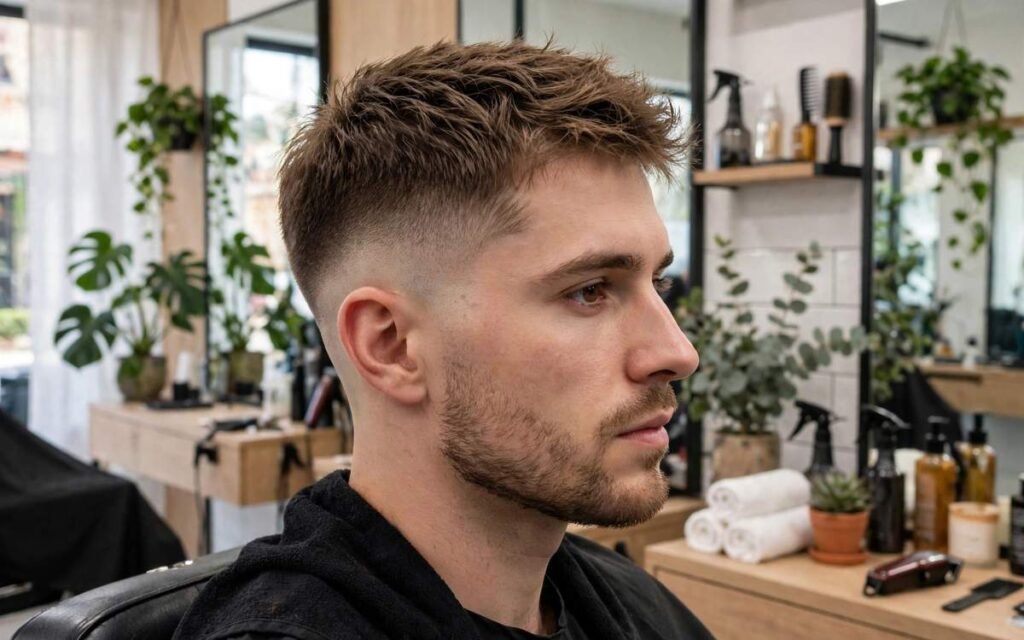
A low taper fade is one haircut with two very different jobs. On fine or thinning hair, it has to protect coverage and keep the scalp from showing. On thick or high-density hair, it has to clean up the perimeter while someone removes weight from inside the shape. The name stays the same, but the specification a barber follows does not.
This guide is for men who want a clean, neat look without guessing. You will learn how a low taper fade works, how to tell your hair type, which 15 styles suit thin and thick hair, how to compare it with mid, high, and skin fades, what to say in the chair, and how to style and grow it out.
What Is a Low Taper Fade?
A low taper fade is a haircut where the sides and back get gradually shorter toward the temples, sideburns, ears, and neckline, while the hair on top stays longer. The fade sits low, hugging the edge of the hairline instead of climbing up the head. The result is a subtle, smooth blend with clean, soft edges rather than a harsh line.
Because the fade is small, it works in an office, at a wedding, or on a weekend. It pairs with buzz cuts, comb-overs, quiffs, curls, twists, afros, and many other hair textures, and the barber can customize every length to your hair type and personal style. That versatility is why it shows up on so many different heads.
What Is the Difference Between a Taper, Fade, and Low Taper Fade?
A taper shortens hair gradually, usually staying at the sideburn and nape areas. A classic taper leaves some length at the bottom, so you see a visible line where hair meets the neckline rather than bare skin. A fade connects around the head, often going over the ear, and the hair blends down to skin or very close to it, producing a visible light-to-dark transition.
A low taper fade is a hybrid. The taper covers a smaller area and leaves more hair through the sides, so it reads as fuller and softer. The fade finish blends the line away at the bottom. Barbers also use terms like shadow taper or skin taper for variations in how close the bottom blend gets. Compared with a full fade, expect softer contrast and a gentler grow-out.
How Does Fade Height and Placement Affect Contrast?
Fade height is the main contrast control. A low transition removes the least side hair, so less scalp shows and the contrast is mild. A mid fade starts higher, and a high fade starts near the parietal ridge, the point where the head curves toward the top. The higher the fade, the wider the band of skin and the sharper, more noticeable the look.
Base length matters too. A skin fade creates stronger contrast between hair and skin, while a guarded transition keeps some length at the bottom. Hair color against scalp color also changes how stark the result looks, and finer or less dense hair shows more scalp. A low guarded taper with a narrow blend is the quiet option; a wide blend is the dramatic one. A taper also tends to grow out softer, which can stretch the time between appointments.
Is a Low Taper Fade Good for Thin and Thick Hair?
Yes, but not with one fixed specification. A low taper fade can work for both thin and thick hair when the fade height, guard sequence, top cut, and internal weight are matched to the person. Thin hair needs the fade kept low and compact so the sides still provide coverage. Thick hair needs the perimeter kept clean while the barber controls bulk inside the shape.
Strand diameter, density, and curl pattern all change the outcome. Fine, low-density, or actively thinning hair behaves differently from coarse, high-density, curly, coily, or high-volume hair, even under the same haircut name. Bring a reference photo of someone with similar hair, because “low taper fade” alone does not tell a barber how much weight to leave above the ears or how much to remove from the top.
How to Identify Fine, Low-Density, Thinning, and Thick Hair
These terms overlap, so separate them:
- Fine hair describes strand width. A single strand is thin, but you may still have plenty of them.
- Low-density hair means fewer hairs per area of scalp. The scalp is easier to see even when strands are normal width.
- Thinning hair means active decline. It can be diffuse thinning across the whole scalp, a receding hairline at the temples, or crown thinning at the vertex.
- Coarse hair means large-diameter strands that feel wiry or heavy.
- High-density hair means plentiful, densely packed strands. Hair can be fine but dense, or coarse but sparse.
A quick check: hold a single strand between your fingers to judge width, then part your hair under bright light to judge how much scalp shows. If you are unsure whether hair is changing over time, a barber or dermatologist can help you tell the difference between hair type and a hair condition.
Does a Low Taper Fade Work for Thin or Thinning Hair?
It can, with limits. The goal is coverage before sharpness. Keep the transition low and compact, and preserve side weight above the ears and at the temples. Match the top direction to your thinning pattern: forward for receding corners, across for a shifted part, and with height at the crown if that area is thinning.
A shadowed or guarded finish usually serves thin hair better than a skin-close finish, especially when your hair is light and your scalp is darker. Ask your barber to avoid aggressive thinning shears; restrained point cutting adds texture without over-thinning. Style lightly with a small amount of product and directional drying, because a heavy wet finish clumps strands and shows scalp. If the density loss is severe, the shape can collapse at the ends, and an alternative may work better.
Is a Low Taper Fade Good for Thick, Coarse, or High-Density Hair?
Yes, thick hair is often where a low taper fade performs best, because the weight above the fade gives the cut plenty of material to work with. The perimeter stays clean and low, while the barber removes weight from inside the shape instead of shortening everything. This keeps natural texture intact.
Without internal weight removal, thick hair can turn boxy or triangular, or form a shelf or mushroom shape where the sides stick out around the parietal ridge. Wavy, curly, and coily hair may need a deliberate outer silhouette instead of thinning. Controlled internal thinning, not scalping the sides, is what makes a coarse top manageable.
How a Low Taper Fade Changes the Appearance of Thin vs. Thick Hair
On thin hair, a low compact transition keeps sides looking full and lets the top read thicker by comparison. A textured top adds a piece-y finish with a matte product, but too much scalp show-through, a harsh contrast, or an overly high fade works against you.
On thick hair, the same fade makes bulk look intentional. Waves, curls, and coils stand out against neat sides, and a messy fringe or textured top looks defined instead of heavy. Frizz and shrinkage matter more here, since curly hair looks shorter when dry. In both cases, what changes the result is the barber’s specification: fade position, blend width, retained side weight, top treatment, and how soon you return for a trim.
Hairline, Crown Thinning, Receding Hairlines, and Cowlick Considerations
Your growth pattern decides what a cut can do. A receding hairline works best with a soft hairline and a top directed forward or across, not pushed straight back, and a conservative temple instead of a pushed-back line-up that exposes more forehead. Crown thinning often looks better with a bit of crown height and a top direction that matches the growth. A crown swirl, double crown, or strong cowlick can fight a flat or slicked style, so ask the barber to customize around it. A minor scar can also change how hair lies.
A haircut cannot treat hair loss. See a dermatologist if you notice a bald patch, clumps of hair coming out, widening part, burning, itching, tenderness, scaly patches, sores, or signs of a fungal infection. This article offers styling guidance, not medical advice.
Best Low Taper Fade Styles for Thin Hair
The best low taper fade styles for thin hair share three traits: a low compact transition, side weight kept above the ears, and a top matched to your pattern. Aim for controlled texture, lift, and light styling instead of a heavy finish.
Low Taper Fade with Textured Crop
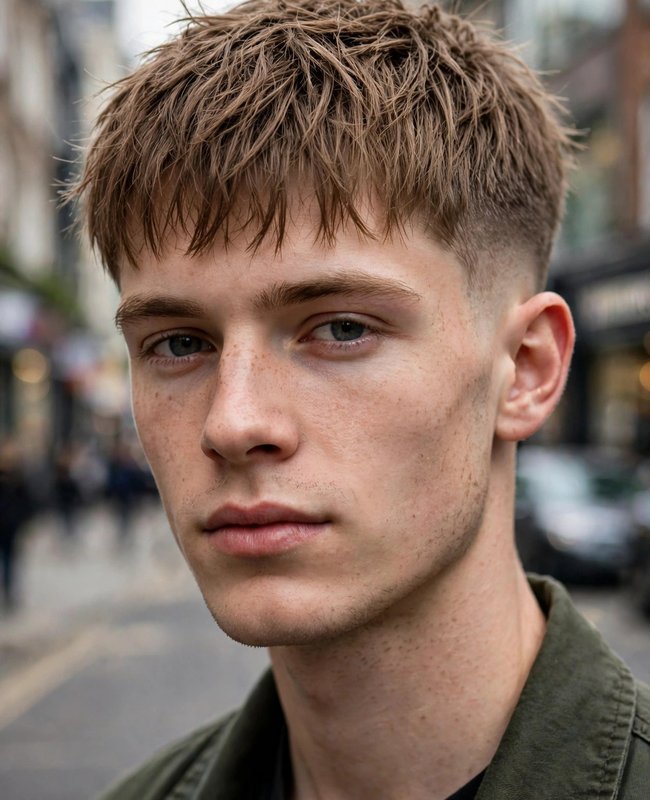
This cut has a short, choppy top with broken layers and a fringe pushed forward, over a soft low taper around the ears and neckline. The texture breaks up diffuse thinning and creates a fuller, thicker look with natural movement. Work in a little matte styling clay or texture powder by fingertip, and blow-dry the front for lift. It is also fairly low maintenance.
Low Taper Fade with Short Caesar or French Crop
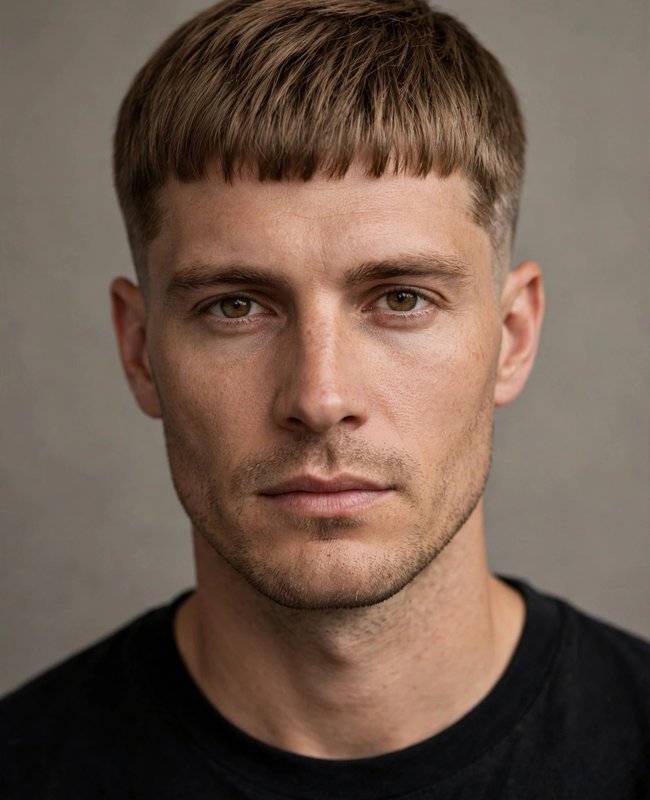
The Caesar cut has short, horizontal bangs and a straight fringe; the French crop adds choppy, textured layers on top. Both keep length short all over so there is little difference to expose. Brushed forward, they can hide receding corners. Pair them with a low taper that blends into skin near the ears. Molding paste adds grip and all-day hold, and there is no part line to maintain.
Low Taper Fade with Short Side Sweep
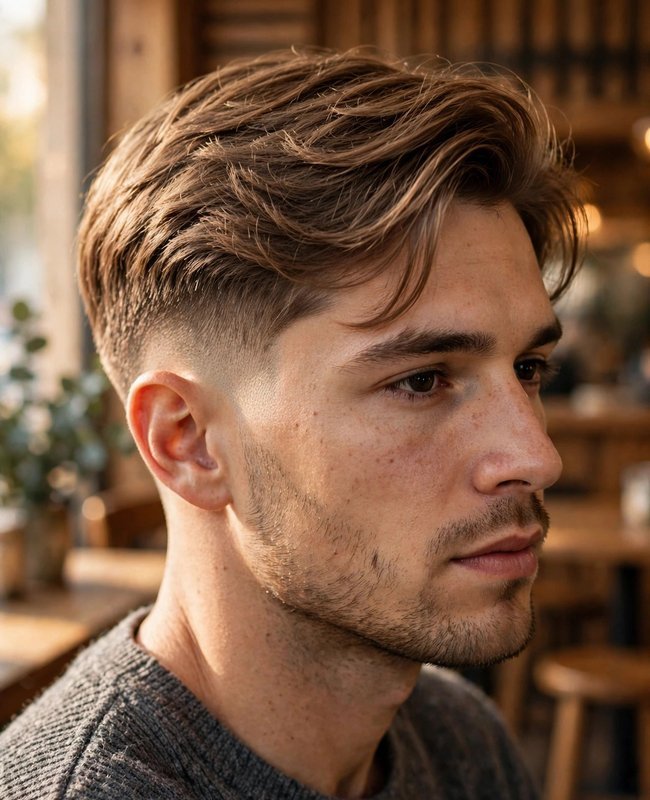
A side sweep brushes the top to one side with soft texture and controlled volume. The direction can lay hair across thinner patches when density is uneven. Keep the low taper gentle and above the ears, with a defined side part if you want a professional style. A light pomade gives shine and hold without clumping.
Low Taper Fade with Restrained Quiff

A quiff lifts the longer front section upward or back, but it is the riskiest option for thin hair. It needs solid frontal density, because lift can expose scalp as easily as it covers it. A restrained quiff keeps the front shorter and the lift modest. Use a hairdryer and brush for lift, texturizing product for body, and a light holding spray instead of stiff product.
Low Taper Fade with Buzz Cut for Thinning Hair

A buzz cut uses one uniform length on top, which reads evenly throughout and camouflages thinning, with a low taper at the sides and back. It is clean, minimal, and needs no product, though you will need routine trims. Keep the top slightly longer than the skin-level fade near the neckline for a subtle, refined edge.
Low Taper Fade with Crew Cut
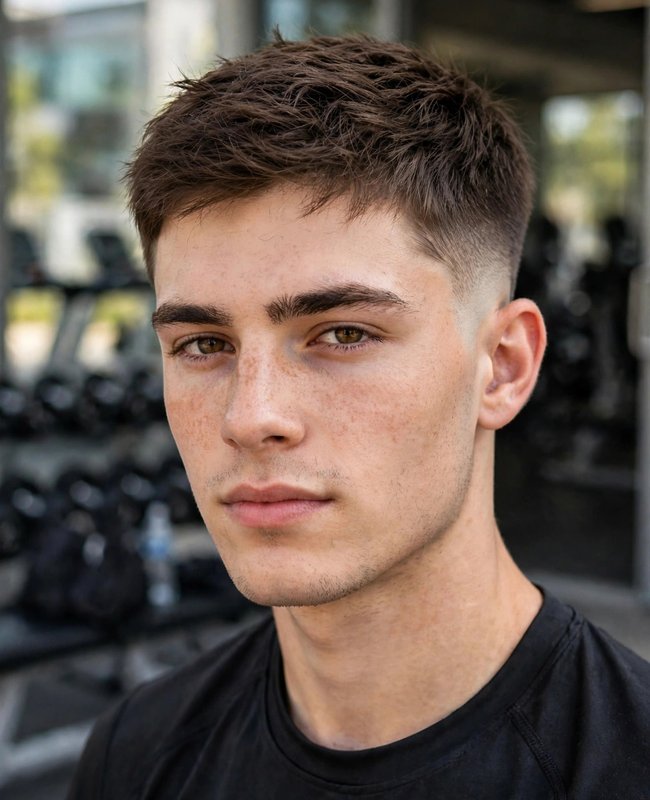
The crew cut keeps a short, neat top with slight texture and subtle lift over a low taper above the ears and neckline. Uniform length gives an even look, and a little matte clay gives structure. It is a timeless clean-cut style that is easy to manage and works well for active schedules.
Best Low Taper Fade Styles for Thick Hair
Thick hair can carry more length, volume, and shape, but each style below depends on internal weight control so the top stays manageable while the perimeter stays clean.
Low Taper Fade with Textured Top
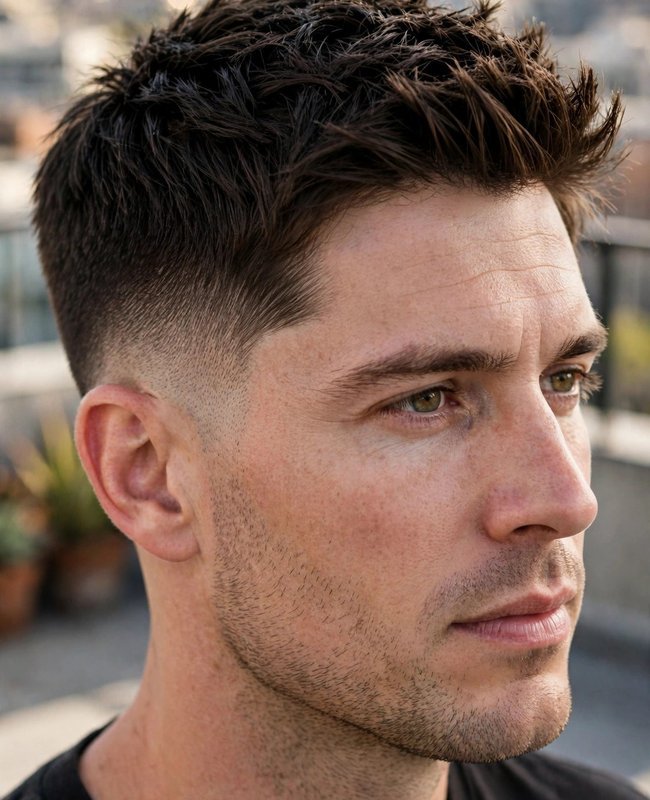
A short textured top with internal thinning gives thick straight hair a defined, piece-y finish without bulk. Use matte clay and finger-tousling, or blow-dry the top forward or up for movement. The clean taper above the ears keeps the contrast sharp without looking harsh.
Low Taper Fade with Messy Fringe
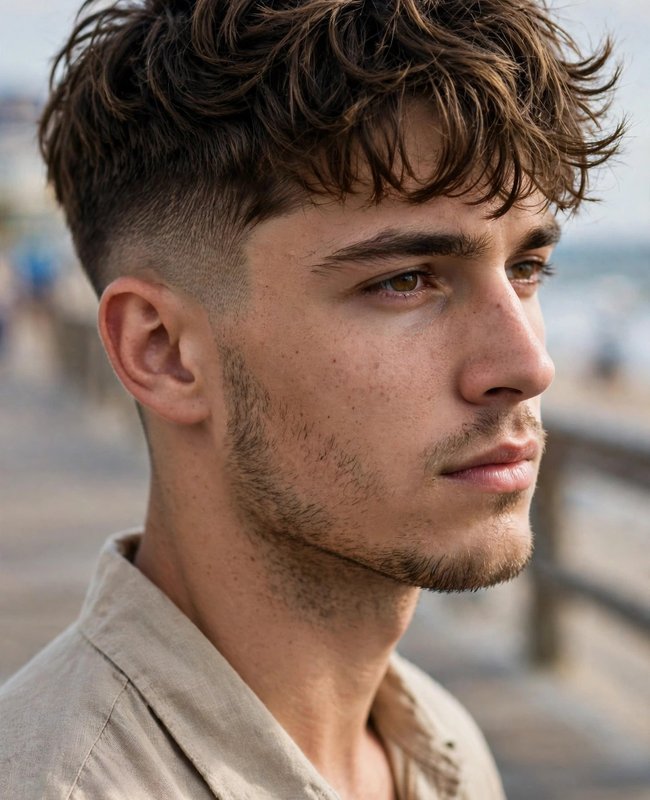
A forward-swept fringe with choppy ends suits dense wavy hair, because texturizing the ends lets waves fall separately instead of as a heavy mass. It frames the face, and a matte cream or texture powder, plus scrunching and a quick blow-dry to lift the waves, finishes it.
Low Taper Fade with Quiff or Side Part
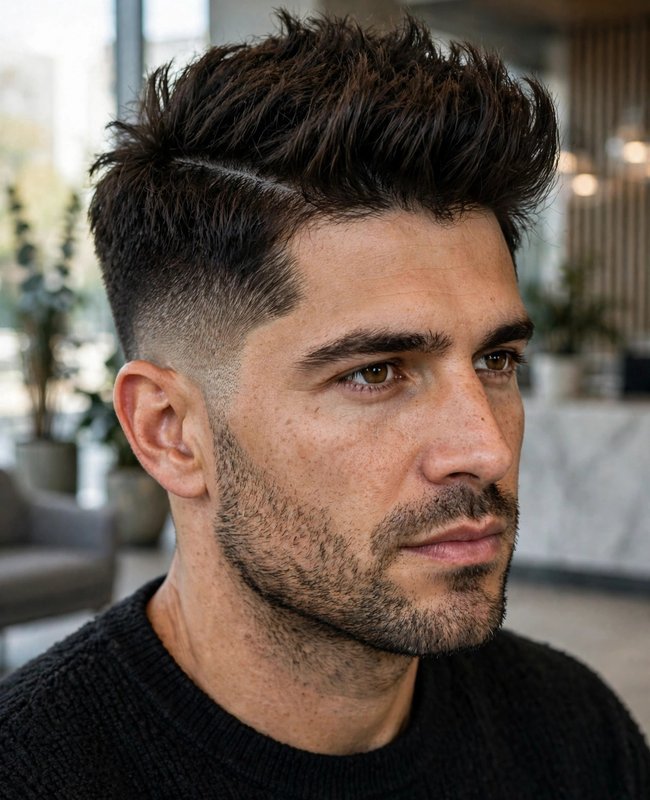
Thick, coarse hair holds a quiff or side part well once the barber removes weight inside the shape. A longer top with a defined side separation gives a polished, professional look. Blow-dry the front up and over, then use pomade for hold and to control frizz. The goal is light volume that looks natural, neither stiff nor flat.
Low Taper Fade with Slick Back or Swept-Back Hair
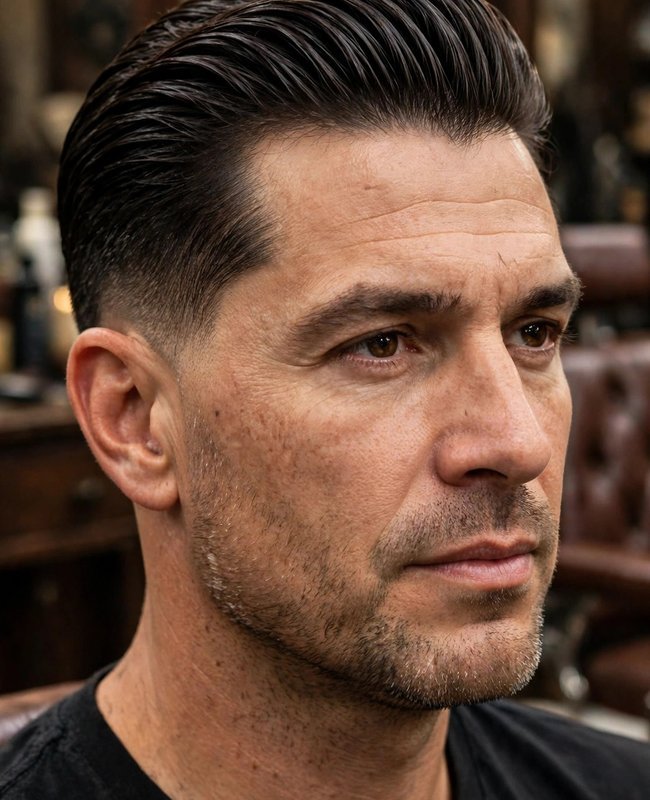
Hair brushed back smoothly shows off natural volume and shine. The low taper at the ears and nape sharpens the look. Use a blow dryer, then a light pomade for hold and shine; a wet finish gives a polished classic vibe. Thick hair needs enough internal weight removal so the back lies flat.
Low Taper Fade with Curly Top and Preserved Temples
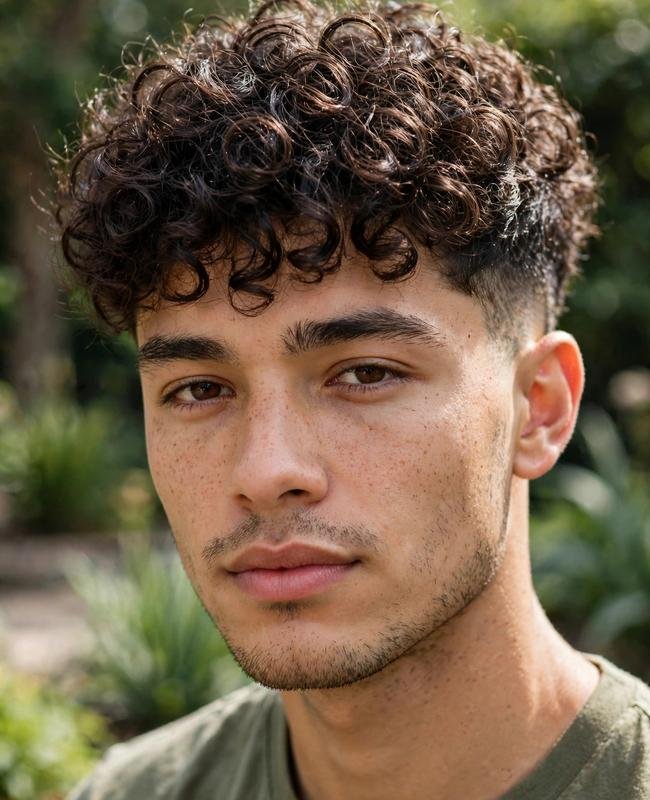
Keep the top longer so curls have room to bounce, and leave density at the temples so the transition does not turn harsh. Trim curl length selectively instead of cutting the whole top. A curl-enhancing cream and a diffuser shape the curls, and a rounded outline looks best when the sides stay neat and blended.
Low Taper Fade with Sculpted Afro or Rounded Coils
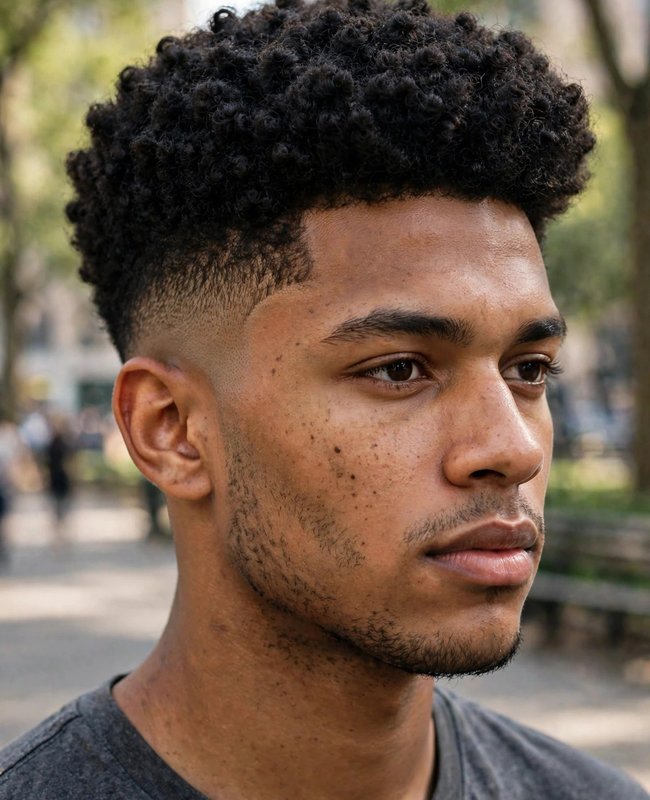
For tight, dense coils, only the perimeter gets tapered. The taper at the hairline and neckline creates sharp contrast against a rounded, cropped top whose shape follows the natural growth pattern. A moisturizing cream and a curl sponge define the coils while keeping volume.
Low Taper Fade with Pompadour
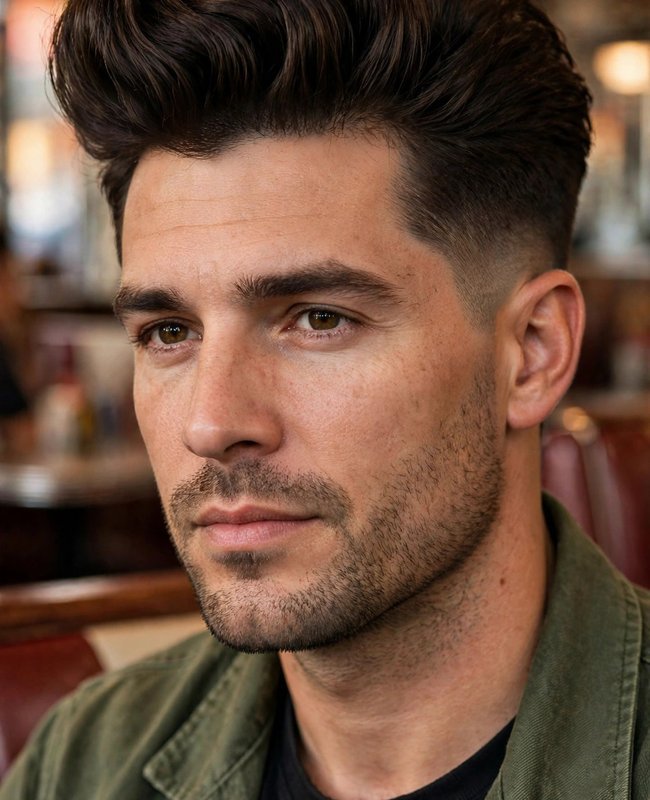
A pompadour sweeps hair upward and back from the forehead, so it needs natural thickness for height. The low taper shortens near the ears and neckline while the top stays full-bodied. Use mousse and a blow dryer for lift, then strong-hold pomade to keep the shape through the day.
Low Taper Fade with Blowout
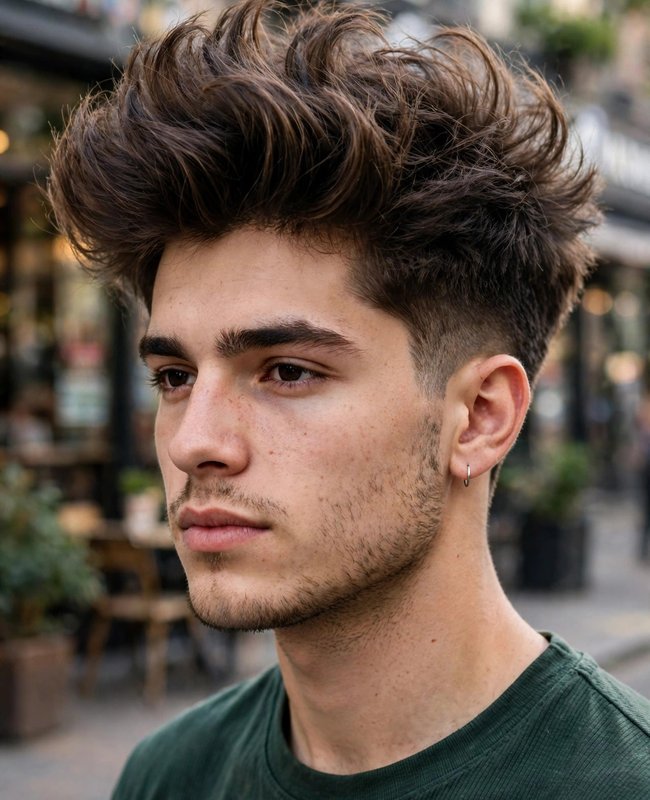
A blowout lifts the top into an airy, fuller silhouette, with more length and lift at the crown and back. Use a round brush and blow dryer, then matte clay for hold. The low taper keeps the sides tightly blended, and a reference photo helps because “blowout” and “blowout taper” are not used consistently.
Low Taper Fade with Undercut
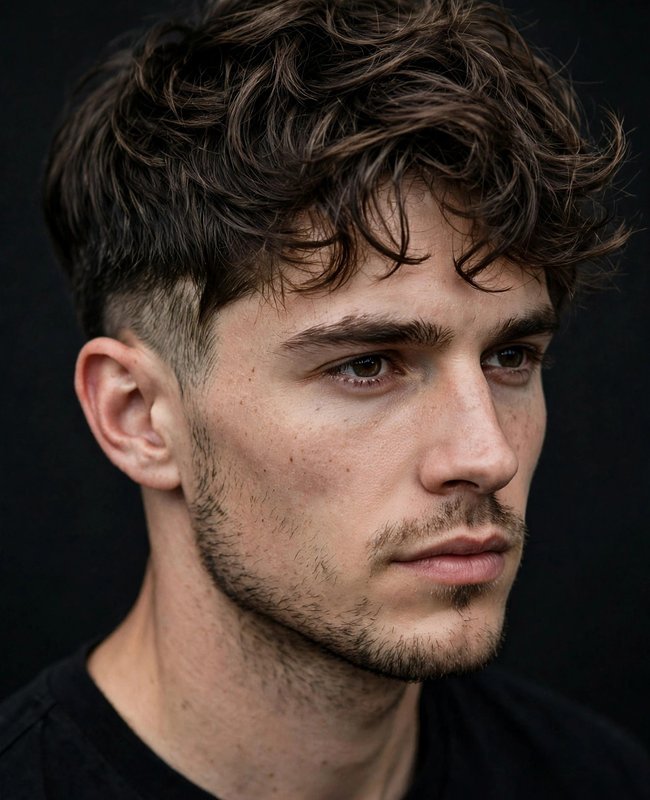
An undercut disconnects the sides from the top. Paired with a low taper, the sides shorten gradually just above the ears, and the top stays longer, such as a medium-length wavy top with messy texture. The visible disconnection removes bulk and creates a sharp silhouette. Use curl-enhancing mousse or matte cream on waves, or pomade for a slicked-back look on straight hair.
Low Taper Fade Comparisons
The main difference between these fades is where the blend starts and how much skin shows. The table below summarizes the differences, followed by the practical trade-offs.
| Low taper fade | Mid taper fade | High taper fade | |
|---|---|---|---|
| Where it starts | Just above the ears, curving around the neckline | Around the middle of the head | Higher, above the ears |
| Contrast | Subtle | Moderate | Strong, sharp |
| Thin hair | Usually the safest, when kept compact | Use with caution | Often exposes too much scalp |
| Thick hair | Clean perimeter, bulk handled inside | Removes weight from a larger area | Can leave a shelf if not blended |
| Maintenance | Grows out softer | Moderate | Looks fresh the shortest time |
Low Taper Fade vs. Mid Taper Fade
The difference is where the fade starts. A low taper starts low, giving a soft fade near the neck and ears and a clean, simple look that suits side-swept and brushed-back styles. A mid taper starts higher, so it is bolder and stands out more. It removes weight from a larger area, which helps dense hair with heavy sides, and it pairs well with messy or curly styles. Both frame a beard or mustache well.
Low Taper Fade vs. High Taper Fade
A low taper begins just above the ears and curves around the neckline, so the look is refined, mature, and easy to maintain. A high taper starts higher and creates a sharp, bold look that suits a faux hawk, messy fringe, or tousled lift. Visibility is the trade-off: the high version commands attention and needs more upkeep, while the low one keeps a neat, classic finish.
Low Taper Fade vs. Low Skin Fade
A low skin fade cuts down to the scalp, leaving bare skin and a sharper, bolder contrast. A low taper fade leaves a gradual blend with a soft transition, often with a guarded finish rather than skin. In ordinary light, the shadowed test applies: if you can see scalp color through the shortest section, it is skin-close. Fine or thin hair often does better with a longer guard.
Low Taper Fade vs. Blowout Taper
A low taper has tightly blended sides and limited top volume. A blowout taper focuses on a lifted, airy top with more length, crown, and back volume, creating a fuller silhouette. The term is inconsistent between barbers, so show a reference photo of the exact regions you want fuller.
How to Choose a Low Taper Fade by Hair Type and Face Shape
Start with hair type, then adjust for face shape, maintenance level, and your daily routine. A barber consultation will fine-tune the proportions, and a reference photo makes the preferences concrete.
Choosing a Low Taper Fade for Straight Hair
Straight hair shows taper lines clearly, so a well-defined, polished blend looks sharp, with smooth flow and a neat finish. Thick straight hair benefits from a textured top with internal thinning, and matte product for a piece-y finish. Fine straight hair needs a lightweight cream and a natural matte finish. Avoid a blunt fringe that creates a bowl-like structure.
Choosing a Low Taper Fade for Wavy Hair
Wavy hair works well with a longer, messy top that keeps soft texture, bounce, and movement. The low taper blends around the ears and removes bulk so dense waves fall separately. Style with sea-salt spray or curl cream, then blow-dry while scrunching, and add texture powder for grip.
Choosing a Low Taper Fade for Curly or Coily Hair
Curly and coily hair gain depth and contrast from a longer top with blended sides. Keep temple weight, leave the shape to the natural growth pattern, and taper only the perimeter. Always evaluate length on fully dry hair, since wet curls are longer and shrinkage shortens them. Avoid over-thinned ends, which lead to frizz; point-cut instead. A curl-enhancing cream, diffuser, and moisturizing product keep hydration up.
Choosing a Low Taper Fade for Fine, Thin, or Thinning Hair
Go subtle and understated: a low compact transition, preserved side and temple weight, and a textured, short, or forward-brushed top. Choose a shadowed or longer-guard finish in place of skin-close if scalp contrast is high, and style lightly with directional drying. Check the result under bright overhead light as well as normal room light, because scalp show-through often appears in harsh lighting.
Choosing a Low Taper Fade for Thick or Coarse Hair
Thick hair can carry a bold shape, but the silhouette is the key decision. Ask for internal weight removal, a blend through the parietal ridge with no visible step, and a deliberate outer shape. Avoid the helmet effect, where the upper sides puff out above the fade line.
Best Low Taper Fade for Oval, Round, Square, and Heart-Shaped Faces
Face shape is a styling consideration, not a rule. Oval faces suit almost any variation. Round faces often benefit from height on top and sharper lines to elongate the face. Square faces can use a softer, gentler fade to round out strong jaw angles. Heart-shaped faces, with a wider forehead and narrower jaw, tend to look balanced with moderate top volume and a fringe that is not too heavy.
Choosing a Low Taper Fade Based on Maintenance Level
The low taper fade is relatively easy to maintain, but upkeep varies. Plan on a trim roughly every 4 to 6 weeks if you are comfortable with a softer grow-out, or every 2 to 3 weeks to keep it consistently crisp. Styling time is usually a few minutes a day for straight or wavy hair, and longer for curly hair that needs drying time and product. Book your next appointment at the end of each visit, and avoid trying to fix the neckline yourself, because self-edging can distort the shape.
How to Ask Your Barber for a Low Taper Fade

Specific, direct communication beats vague phrases like “just a fade” or “whatever works.” Say where the fade should start and end, how short the shortest section should be, how the top should be styled, and how much styling time you have. Bring reference photos of a similar style, and listen to your barber’s feedback on how your hair type changes the plan.
What to Tell Your Barber for Thin, Fine, or Thinning Hair
- Keep the fade low and compact, starting near the ear.
- Preserve weight above the temples to keep a shadowed look rather than exposing scalp.
- For diffuse thinning, keep the top textured, not too short.
- For receding corners, direct the top forward, not straight back.
- For crown thinning, leave height at the crown.
- Avoid aggressive thinning shears; ask for restrained point cutting.
- Check the cut under bright overhead light.
What to Tell Your Barber for Thick or High-Density Hair
- Remove bulk from inside the shape, not by shortening everything.
- Keep the perimeter clean and connected.
- Do not flatten natural texture; for straight coarse hair, use fine internal thinning, and do not cut the top close to the skin.
- For wavy or curly hair, check the shape dry so the length is accurate.
- Blend through the parietal ridge so there is no visible step, and avoid thinning against the grain, which causes stray ends.
- Confirm the finished silhouette, and avoid a shelf or mushroom shape.
Reference Photos and Barber Consultation Checklist
Choose photos of someone with similar density, texture, and hairline, and ideally front, side, and back angles. Tell the barber which details you want and which you do not. Then cover:
- Fade height and where the clippers start
- Top length and sideburn shape
- Neckline shape and line-up choice
- How much scalp exposure is acceptable
- Your daily styling minutes
- Your grow-out expectation
If a past cut worked, tell the barber the clipper guard length, because barbers do not always remember past cuts.
Choosing the Right Length and Preserving the Hairline
Top length changes the whole look. Shorter gives a bold, sharp finish; medium gives balance; longer gives a relaxed style. Let face shape, hair texture, and your daily routine guide the decision. Preserve a natural hairline: keep the outline clean but not pushed back, and avoid a razor outline on an uneven or receding hairline. A symmetrical neckline should be deliberate, with balanced temple height on both sides.
Non-Negotiables for a Clean Low Taper Fade
- Smooth blend with no visible lines or hard breaks between guard sizes
- Consistent blend height across the whole head
- Balanced height at the temples
- A deliberate, symmetrical neckline with no accidental gaps
- A clean outline that is not pushed back
If a cut misses any of these, say so politely before you leave.
How to Style a Low Taper Fade
The faded perimeter needs almost no daily attention, and regrowth blurs the line over time. Styling is mostly top work, and it depends on density and texture. The routine below follows the same step-by-step logic for every texture: set the direction, add a little product, and finish.
Daily Styling Routine for Thin or Fine Hair
Partially air-dry first, and avoid combing soaking-wet hair, which can cause breakage. Blow-dry with your fingers in the direction you want for root lift and height. Use a small amount of lightweight product, and keep heavy creams away from the roots. Separate strands with your fingers instead of a fine-tooth comb. Check the crown in normal room light with a close-up mirror. For extra fullness, scrunch weightless mattifying powder into dry roots to absorb excess oil with no residue.
Daily Styling Routine for Thick, Coarse, Curly, or Coily Hair
For straight coarse hair, towel-dry, work in light cream, set the shape while damp, and finish with matte paste. For curly or coily hair, apply product to soaking-wet hair, scrunch or twist, and let it air-dry or diffuse. Do not comb through the pattern. Detangle while wet, and brush wet only if your hair type tolerates it, because textured hair breaks more easily dry. Shrinkage is normal: wet, just-cut hair looks longer than dry hair. Curl cream, moisturizing cream, and a volumizing mousse help, and a crown lift with a blow dryer adds height.
How to Add Texture, Volume, and Natural Movement
Sea-salt spray before blow-drying gives grit. Lift the roots with a dryer, tousle with your fingers, and lock the shape with a clay or paste. Texture clay offers strong hold and a matte finish for structured, voluminous styles; molding paste gives medium hold with a natural finish for casual, flexible looks. Layer products lightly to avoid buildup.
Combing and Brushing Techniques
A fine-tooth comb suits sleek styles, while a vent brush adds volume and control while drying. Combing in the direction of growth, including the direction the fade falls, helps maintain structure. A wide-tooth comb preserves curl definition. Use a round brush for lift, a wave brush for brushed-back looks, and a comb for side-swept or comb-over styles.
Choosing the Right Styling Products for Your Hair Type
| Product | What it does | Best for |
|---|---|---|
| Matte clay or paste | Strong or medium hold, no shine | Textured tops, thick hair |
| Texture powder | Dry grip and lift, absorbs oil | Fine or thin hair |
| Pomade or wax | Hold plus shine, polished finish | Slick back, side part, pompadour |
| Mousse | Light body and lift | Quiffs, blowouts, curls |
| Sea-salt spray | Grit and relaxed texture | Wavy hair |
| Curl cream or moisturizing cream | Definition, hydration, frizz control | Curly and coily hair |
Fine, thin hair does best with light styling cream or powder; thick, curly hair can handle richer products. Use a gentle shampoo, a leave-in conditioner, and a drop of oil for dryness. Wash only as often as your scalp needs, and use only as much product as you need.
Low Taper Fade Maintenance and Grow-Out
A low taper fade is a low-maintenance style for busy people, with regular upkeep keeping the fade sharp and the hair healthy. It looks polished at the workplace and casually elsewhere. The sections below cover trims, daily care, volume, bulk, grow-out, and growth quirks.
How Often Should You Get a Low Taper Fade Trimmed?
Booking depends on how close the shortest section is and how crisp you want it. As a general guide:
- Skin-close finish: about 10 to 14 days before it softens
- Guarded fade: about 3 to 4 weeks
- Low guarded taper: about 4 to 5 weeks
- Consistently sharp: every 2 to 3 weeks
- Stretching appointments: 4 to 5 weeks, with the fade lasting around 4 to 6 weeks before it loses sharpness
These vary with hair growth speed, shortest length, desired contrast, and density. Book your next appointment at the visit instead of waiting until the cut looks overgrown, and ask whether a quick neckline and sideburn tidy is available between full cuts.
Daily Hair Care and Maintenance Routine
In the morning, lightly dampen the hair, style it with a comb or brush, and apply a light product for shape without stiffness. Wash two to three times weekly with a gentle shampoo if your hair is dry or textured, and rinse with water on non-wash days. Leave-in conditioner or a few drops of oil keep hair soft and the scalp balanced, and over-washing strips moisture. Use the right products daily, and keep the routine short.
How to Maintain Volume in Thin Hair
Use light styling, a small amount of product, and directional drying for root lift. Separate strands with your fingers to prevent a wet finish and clumped strands that expose scalp. Dry roots and scrunch in texture powder for a fuller look in seconds. Keep the top short with choppy, broken layers, and brush the fringe forward. Check your hair in bright overhead light as well as normal room light.
How to Control Bulk and Puffiness in Thick Hair
Puffiness appears when the weight is planned poorly: a helmet effect, upper sides that puff out, or a shelf at the ridge where the fade stopped abruptly at the parietal ridge. Ask the barber to extend the blending zone and use internal thinning, not blunt thinning, because bluntly thinned ends frizz. Curls look shorter after drying, so assess dry. Volumizing mousse, dry shampoo, and blow-drying for crown lift help with shape definition.
How to Maintain a Clean Grow-Out
As hair grows, the fade line blurs and contrast fades. A taper grows out softer, and a skin fade grows out faster. Keep the neckline and sideburns tidy with a precision trimmer for clean lines, and avoid self-edging, which can distort the shape. For curly hair, new growth adds height, not length, so shrinkage is easy to misjudge. Evaluate dry, and keep a schedule that matches your work and lifestyle.
Managing Cowlicks and Uneven Hair Growth
Strong growth patterns, such as a double crown, crown swirl, or cowlick, change how a cut sits. Ask the barber to cut with the growth direction and customize the top direction: forward, across, or up. For uneven density or thinner patches, a side sweep can help. Avoid a pushed-back line-up, which exposes the forehead. Evaluate the cut dry and wet, and leave some styling time.
Low Taper Fade Mistakes to Avoid
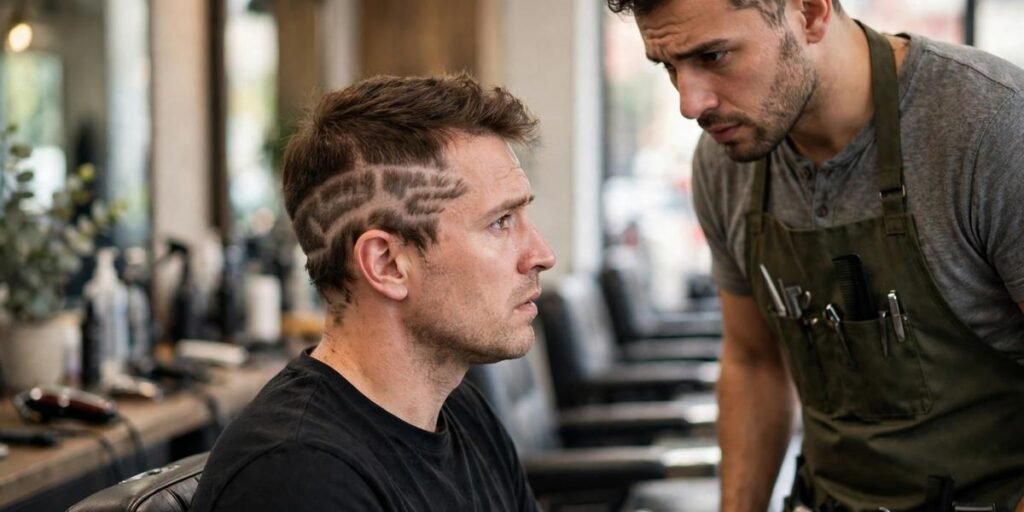
Most bad results trace back to vague instructions or a mismatch between the cut and the hair. Skip phrases like “just a fade” and tell the barber the sideburn shape, neckline preference, and clipper guard length. Do not assume the barber remembers past cuts, and re-explain your preferences each time.
Choosing a Fade That Makes Thin Hair Look Thinner
A high fade, wide fade, or hard disconnection between top and sides can expose scalp, especially with light hair on a darker scalp. A low narrow fade with a guarded or shadowed finish is safer. Do not leave a long, sparse top; style it dry with light lift and avoid aggressive thinning shears. For severe diffuse thinning, a soft blended line is better.
Fading Too High or Removing Too Much Density
A mid or high fade is sharper but creates a wider band of skin, and the difference between hair and scalp color makes it more noticeable. A skin fade also gives stronger contrast. Over-thinning sparse hair with point cutting or thinning shears removes the density you need, and the shape collapses at the ends. Keep side and temple weight.
Removing Too Much Bulk from Thick Hair
Cutting everything shorter loses top length, shape, and texture. Internal thinning against the growth direction leaves stray ends, and over-thinned or bluntly thinned ends frizz. Scalped sides leave a mushroom or boxy silhouette. The better approach: thin inside the shape, blend through the parietal ridge, and confirm the shape when dry.
Ignoring Hairline, Crown, and Cowlick Patterns
Cutting against a strong growth pattern, a crown swirl, or receding corners leads to a style that never sits right. Choose the top direction (forward, across, or up) to suit the pattern, keep temples conservative, and avoid a pushed-back line-up. If you notice signs of hair loss or scalp irritation, see a dermatologist; this is styling guidance, not medical advice.
Choosing the Wrong Top Length or Styling Technique
The top length should suit your face shape, hair texture, and routine. Thin hair needs a short, textured, or directed top, not a thinned flat one. Heavy product and a wet finish clump strands. Frequent blow-drying and combing wet hair cause breakage, and curly hair should be scrunched or twisted, not combed through. Evaluate shrinkage when dry.
Overusing Heavy Styling Products
Heavy creams at the roots flatten fine hair, create a wet finish, clump strands together, and show scalp. Use a small amount of lightweight product, matte paste on damp hair, and layer lightly to avoid buildup. Excess oil and residue weigh hair down; a weightless powder or styling cream gives a natural finish. Wash with a gentle shampoo and condition properly.
Best Alternatives to a Low Taper Fade
A low taper fade is rarely wrong outright, but it can disappoint when you expect more scalp contrast than it gives, when it fights a strong growth pattern, or when you will not make the appointments. Alternatives handle insufficient coverage, uncontrolled bulk, or a bigger structural change that a perimeter taper cannot provide.
Best Alternatives for Thin or Thinning Hair
- Classic scissor taper: softer contrast with no clipper-to-skin transition.
- Soft short back and sides: blends without exposing scalp.
- Textured French crop or Caesar: short length all over leaves little to expose, with a forward-brushed top and no part line.
- Uniform buzz cut or crew cut: reads evenly throughout, though the camouflage stops working if you go too short against a visible scalp.
Best Alternatives for Thick or High-Density Hair
- Scissor taper: softer transition and less frequent maintenance.
- Mid taper: weight removal across a larger area for dense hair with heavy sides.
- Layered short back and sides: bulk removal with no hard line.
- Undercut: visible disconnection that removes bulk, best for dense tops.
- Longer textured cut: keeps the texture and reduces edge maintenance, using the same internal-thinning logic.
When a Low Taper Fade Is Not the Right Choice
Skip it if you have severe diffuse thinning with light hair on a darker scalp, where a wide fade area exposes scalp and wet styling clumps strands. Reconsider it if you want a hard, pushed-back line-up that exposes the forehead on a soft hairline, if a strong growth pattern fights the shape, or if you will not realistically make the appointments. In those cases, consult your barber and bring reference photos of a softer cut.
FAQs
Does a Low Taper Fade Work With a Receding Hairline?
Yes, with careful customization. A low taper cannot reverse recession, but it can draw less attention to it. Keep the hairline soft, keep temples conservative, and brush the top forward or across, not straight back. Short tops like a Caesar, French crop, or short fringe work well, and a hard line at the hairline should be avoided. Check the result in bright overhead light and in normal room light for scalp show-through.
Should Fine Hair Be Faded to Skin, Zero, or a Longer Guard?
There is no universal answer. It depends on hair and scalp contrast in ordinary light. A guarded or shadowed finish is usually safer for fine hair than skin-close, because bare scalp shows more. Test it: if you can see scalp color through the shortest section, you are close to skin. If unsure, start with a longer guard; it is easier to go shorter at the next appointment than to wait for regrowth. Keep the fade narrow and the transition low and compact.
What Type of Fade Is Best for Thin Hair?
A low, compact transition with a guarded, shadowed finish is usually best, not skin-close. Preserve side and temple weight, then pair it with a textured crop, short Caesar or French crop, short side sweep, restrained quiff, buzz cut, or crew cut, matching the top direction to your pattern. Where scalp contrast is high, a classic scissor taper or soft short back and sides may be even better.
Who Should Get a Low Taper Fade?
Men who want a clean, neat look with minimal fuss. It works across straight, wavy, curly, and coily hair and various face shapes, and it suits work, casual, and special occasions. It can read modern or classic, refined or youthful, depending on the top. Thinner hair and thicker hair both work, but with different specifications. Bring a reference photo and tell your barber your styling time and the edge you want.
Can a Low Taper Fade Be Blended Into a Beard?
Yes. The sideburn can blend straight into the beard for a continuous line, or you can leave a deliberate gap for contrast. Beard density, symmetrical growth, and beard shape matter. A low taper around the ears and nape pairs well with a thick, well-groomed beard, a lined full beard, a goatee, or a light beard, and it also works with a clean shave. Ask your barber to match the sideburn and neckline shapes.
Can Curly or Coily Hair Keep a Rounded Shape With a Low Taper?
Yes, if only the perimeter is tapered. Temple, side, and crown weight stay, so the curl pattern keeps supporting the rounded shape. Evaluate the cut on fully dry hair, because wet curls look longer and dry curls shrink. A curl-enhancing cream, diffuser, curl sponge, and moisturizing cream support definition. Trim curl length selectively and avoid a harsh transition at the temples.
Can You Get a Low Taper Fade Without a Sharp Line-Up?
Yes. The taper and the line-up are separate decisions. You can have the temples and neckline tapered with a soft, natural frontal hairline and no razor outline, which is often better for uneven or receding hairlines. Ask for a clean outline that is not pushed back, a deliberate symmetrical neckline, and balanced temple height.
How Long Does a Low Taper Fade Last?
Most low taper fades look fresh for about 4 to 6 weeks before they grow out and lose sharpness at the neckline and sideburns. For a crisper look, touch up every 2 to 3 weeks. Skin-close finishes soften in about 10 to 14 days, guarded fades in 3 to 4 weeks, and low guarded tapers in 4 to 5 weeks. Hair growth speed, shortest section length, and desired contrast all change this.
What Is the Difference Between a Low Taper Fade and a Mid Taper Fade?
A low taper fade starts low, near the neck and ears, for a soft, clean, simple look. A mid taper fade starts higher, around the middle of the head, so it is bolder and stands out more. The mid version removes weight from a larger area, which suits dense hair with heavy sides, while the low version suits side-swept or brushed-back styles. Choose by contrast, hair type, and how much edge you want.
good style